

-
Product
-
-
Service Policy
-
-
Blog
-
Join Us

Service Support
Always adhere to providing customers with professional technical solutions and high-quality service experiences
Do vertical long-shaft pumps have axial窜量?
Vertical long-shaft pump Axial displacement exists during normal operation, which is determined by its structural characteristics and working principle. The following explains the causes of axial displacement, influencing factors, and control methods:
I. Causes of Axial Displacement
Axial force
When the vertical long-shaft pump is operating, the impeller rotation will generate axial force (caused by the pressure difference on both sides of the impeller, pointing to the suction end), pushing the pump shaft to move axially. In addition, the reaction force of the liquid flow and impeller machining errors may also exacerbate the influence of the axial force.
Thermal expansion effect
During pump operation, the shaft and bearings and other components will generate heat due to friction or changes in the medium temperature, causing thermal expansion, resulting in a slight change in the length of the shaft, forming axial movement.
Assembly and installation errors
The assembly clearance between the pump shaft and bearings, impeller, and other components, or the coaxiality deviation during overall installation, may cause unexpected axial displacement of the shaft during operation.
II. Influence of Axial Displacement
Positive impact
Reasonable axial displacement can prevent the shaft from being "stuck" due to thermal expansion or axial force, ensuring the relative movement flexibility between components.
Negative impact
If the axial displacement is too large, it may cause friction between the impeller and the pump casing, shaft seal, and other components, increasing wear and tear, and even causing vibration, noise, or seal failure;
Under the long-term action of axial force, the bearing load increases, which may shorten the bearing life, and in severe cases, cause bearing burnout.
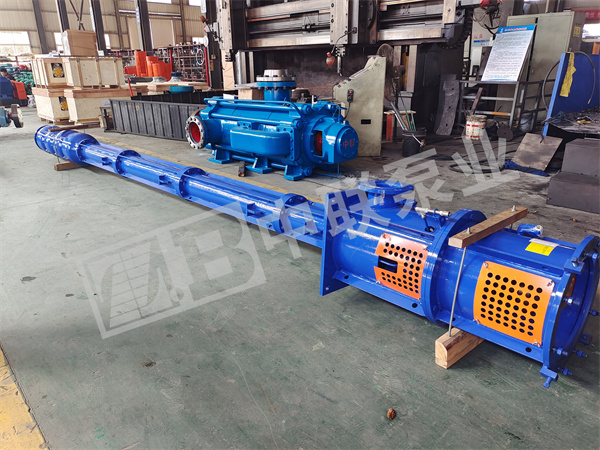
[For more information on models, parameters, and selection quotation schemes for vertical long-shaft pumps, please click on the image above]
III. Control and Limitation of Axial Displacement
Structural design optimization
Balancing device: By setting balancing holes, balancing plates, or balancing drums, part of the axial force is offset, reducing axial displacement. For example, the balancing plate can generate reverse thrust by adjusting the gap to balance the axial force;
Thrust bearing: Install high-precision thrust bearings (such as thrust ball bearings, tapered roller bearings) to directly limit the axial displacement of the shaft and simultaneously bear the axial force.
Gap control
During assembly, strictly control the axial clearance between the shaft and bearings, and the impeller and pump casing (usually 0.1~0.5mm, specifically determined according to the pump model and operating conditions), and adjust the gap accuracy through shims and positioning sleeves.
Monitoring and maintenance
During operation, the axial displacement is monitored by sensors. When the displacement exceeds the allowable value (such as 1.5 times the design value), an alarm is triggered, and the bearing wear, balancing device status, or installation accuracy is checked in time.
IV. Typical Cases and Industry Standards
In large vertical long-shaft condenser pumps (such as those used in thermal power plants), the axial displacement is usually controlled within 0.2~0.3mm to ensure the stability of the axial clearance between the impeller and the guide casing and avoid a decrease in pump efficiency due to excessive displacement;
Industry standards (such as GB/T 5657-2019 "Technical Conditions for Centrifugal Pumps") clearly stipulate the allowable range of axial displacement. Pumps under different operating conditions should be designed and accepted according to the standards.
Summary
Vertical long-shaft pump Axial displacement is an unavoidable physical phenomenon, but it can be controlled within a safe range through reasonable structural design, precise assembly, and real-time monitoring. If abnormal vibration, increased noise, or increased bearing temperature is found during pump operation, it may be caused by excessive axial displacement, and timely inspection and adjustment are required.
Related News

Hotline:
+86 0731-88632200
Export Trade/Technical Support:
+86 153-4831-2290
Head Office Email:
zoomlian@yeah.net
No. 210, Huanbao Zhong Road, Yuhua District, Changsha City, Hunan Province, Leowoju Wisdom Valley Building B, 8th Floor
Quick Navigation


Hot Products
Online Consultation
Powered by:www.300.cn Changsha SEO