

-
Product
-
-
Service Policy
-
-
Blog
-
Join Us

Service Support
Always adhere to providing customers with professional technical solutions and high-quality service experiences
What kind of media are chemical process pumps mainly used to transport?
Chemical Process Pump It is a pump model with a separate name in the chemical pump type. What kind of material is this type of chemical process pump mainly used to transport?
From a professional point of view, the material selection of chemical process pumps is far more complex than that of ordinary pumps. Many users only pay attention to the medium during selection, ignoring the fact that temperature and pressure are equally critical. As the "heart" of the chemical production line, the material selection of chemical process pumps directly depends on the chemical properties, temperature, pressure, particulate matter content, and cleanliness requirements of the transported medium. The core principle is to resist corrosion, wear resistance, and ensure safety and longevity.
We can understand what materials chemical process pumps can transport from the following aspects? Or in other words, how to choose the pump model according to the medium?
If you are transporting the following types of media, you can choose the pump body material according to the properties of the medium.
Metallic materials (corrosion-resistant/high-temperature and high-pressure resistant)
Austenitic stainless steel (mainstream choice)
304/304L: Transporting weakly corrosive media (room temperature dilute sulfuric acid, organic solvents), high cost performance.
316/316L (containing molybdenum): Resistant to moderate corrosion (phosphoric acid, acetic acid, seawater), the most commonly used in the chemical industry.
904L/254SMO (super austenitic): Resistant to strong acids (concentrated sulfuric acid), media containing chloride ions (such as brine).
Applicable scenarios: Acid/alkali solutions, organic solvents, process water transportation.
Duplex stainless steel (strength + corrosion resistance)
2205 (S31803): Resistant to chloride stress corrosion, used in media containing chlorine (seawater, bleach).
2507 (S32750): Pitting corrosion resistance exceeds 316L, suitable for high-temperature chlorine-containing environments (such as desulfurization systems).
Advantages: The strength is twice that of 316L, reducing the pump wall thickness to reduce costs.
Nickel-based alloy (extreme corrosion)
Hastelloy C276 (Ni-Mo-Cr): Universal corrosion resistance, resistant to boiling hydrochloric acid, mixed acid (nitric acid + hydrofluoric acid).
Monel 400 (Ni-Cu): Resistant to hydrofluoric acid, high-temperature alkaline solutions (such as caustic soda evaporation section).
Inconel 625 (Ni-Cr): Resistant to high-temperature oxidation (flue gas desulfurization).
Scenarios: Strong acids (hydrochloric acid, hydrofluoric acid), high-temperature and high-concentration alkaline solutions.
Titanium and titanium alloys
Gr.2 (industrial pure titanium): Resistant to seawater, wet chlorine gas, sodium hypochlorite (core material in the chlor-alkali industry).
Gr.5 (Ti-6Al-4V): High-strength corrosion resistance, used in aerospace-grade chemical pumps.
Lined pump (metal shell + non-metal lining)
Fluoroplastic lining (FEP/PTFE/PFA):
Resistant to strong acids/strong alkalis: Concentrated sulfuric acid, hydrofluoric acid, aqua regia (reactor feed pump).
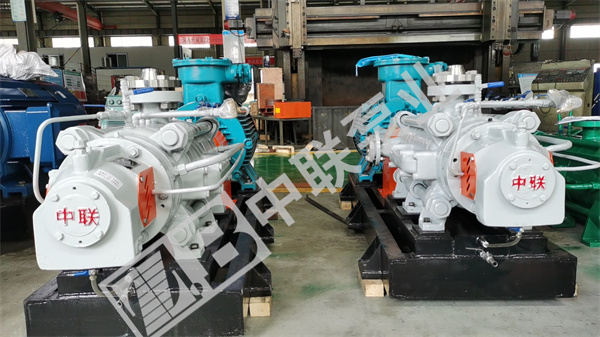
【For more information on DF series multi-stage chemical pumps, models, parameters, and selection quotation schemes, please click on the picture above】
Disadvantages: Weak resistance to negative pressure difference and wear resistance.
Non-metallic materials (strong corrosion resistance/high cleanliness)
Rubber lining (natural rubber/butyl rubber): Resistant to abrasive slurries (mine acid leaching pump).
All-plastic pump (light corrosion/clean medium)
PP (polypropylene): Acid/alkali solutions ≤80℃ (wastewater treatment dosing pump).
PVDF (polyvinylidene fluoride): Resistant to solvents (acetone, toluene), high-purity medicinal solutions (semiconductor industry).
Ceramic pump (ultra-wear-resistant/ultra-high purity)
Aluminum oxide/silicon carbide ceramic:
Resistant to particle abrasion (slurry with solid content ≤30%, such as titanium dioxide transportation).
Zero metal contamination (lithium battery materials, electronic-grade chemical pumps).
Of course, the corrosiveness of the same medium will change greatly under different concentrations/temperatures (such as 80% sulfuric acid using carbon steel, 30% sulfuric acid requires 316L). Material selection must be based on the actual on-site conditions.
Related News

Hotline:
+86 0731-88632200
Export Trade/Technical Support:
+86 153-4831-2290
Head Office Email:
zoomlian@yeah.net
No. 210, Huanbao Zhong Road, Yuhua District, Changsha City, Hunan Province, Leowoju Wisdom Valley Building B, 8th Floor
Quick Navigation


Hot Products
Online Consultation
Powered by:www.300.cn Changsha SEO