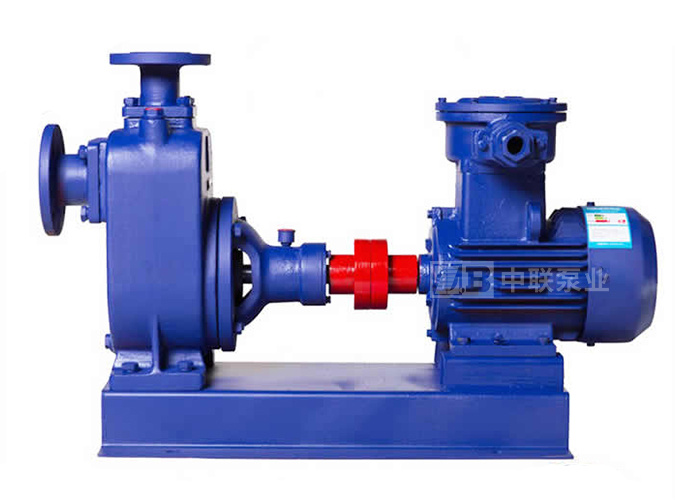
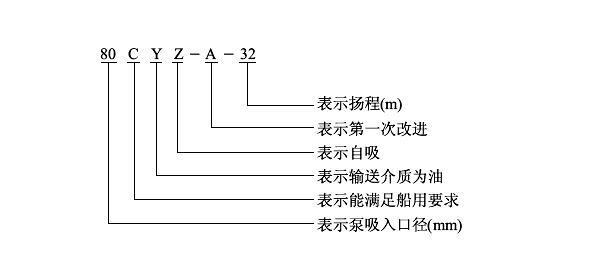
Meaning of the CYZ Horizontal Self-Priming Centrifugal Oil Pump Model:
Structural Diagram and Key Features of the CYZ Horizontal Self-Priming Centrifugal Oil Pump:
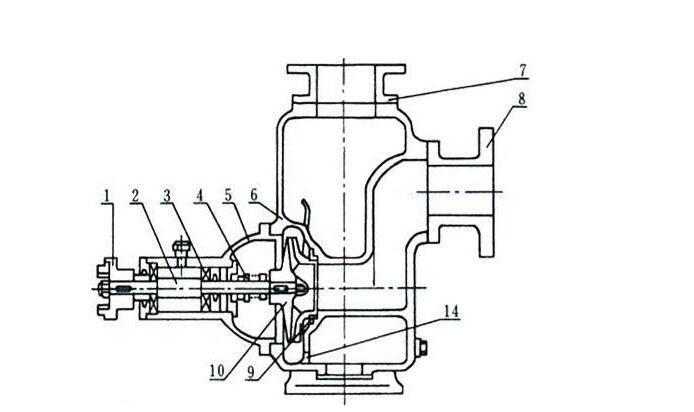
1 Coupling, 2 Pump shaft, 3 Bearing, 4 Mechanical seal, 5 Bearing housing, 6 Pump casing, 7 Outlet seat, 8 Inlet seat, 9 Front sealing ring, 10 Impeller, 11 Rear cover, 12 Water stop ring, 13 Liquid filling port, 14 Return liquid port
The CYZ self-priming centrifugal oil pumps all adopt a pump body structure with axial return flow. The pump body consists of an suction chamber, a liquid storage chamber, a volute chamber, return flow ports, and a gas-liquid separation chamber. After the pump is started normally, the impeller draws in both the liquid stored in the suction chamber and the air from the suction pipeline, thoroughly mixing them within the impeller. Under the action of centrifugal force, the liquid entrains the gas and flows toward the outer edge of the volute chamber, forming a white foam band of a certain thickness and a high-speed rotating liquid ring at the impeller’s outer periphery. The gas-liquid mixture then passes through a diffuser tube into the gas-liquid separation chamber. At this point, due to the sudden decrease in flow velocity, the lighter gas separates from the mixed gas-liquid stream. The gas continues to rise and is discharged through the pump’s outlet. The degassed liquid returns to the liquid storage chamber and, via the return ports, re-enters the impeller, where it once again mixes with the gas drawn in from the suction pipeline. Under the high-speed rotation of the impeller, the liquid flows outward toward the impeller’s outer edge once more... This process repeats continuously, causing the amount of air in the suction pipeline to gradually decrease until all the air is exhausted, thus completing the self-priming process and enabling the pump to operate normally. Because of this unique venting capability, the pump can handle liquids containing gas without the need for a foot valve. When used on oil tankers, it exhibits excellent tank-cleaning performance.
Some pumps are equipped with cooling chambers at the bottom of the bearing housing. When the temperature of the bearing rises above 70℃ due to heating, cooling liquid can be injected through any one of the cooling liquid pipe fittings located in the cooling chamber to initiate a circulating cooling process. The sealing mechanism inside the pump that prevents leakage of liquid from high-pressure areas to low-pressure areas consists of front and rear sealing rings. The front sealing ring is mounted on the pump body, while the rear sealing ring is mounted on the bearing housing. If, after prolonged operation, the sealing rings wear to a certain extent and begin to affect the pump’s efficiency and self-priming performance, they should be replaced.
Product features:
1. The CYZ-type oil pump is a self-priming centrifugal pump that boasts advantages such as simple structure, convenient operation, stable performance, easy maintenance, high efficiency, long service life, and strong self-priming capability. It does not require a foot valve in the pipeline; before starting operation, it suffices to ensure that the pump body contains a sufficient quantity of priming oil. When used on oil tankers or water transport vessels, this pump can also serve as a bilge pump, delivering excellent bilge-cleaning performance.
2. The CYZ self-priming oil pump is meticulously crafted from high-quality materials and features a mechanical seal made of hard alloy, ensuring long-lasting durability. The discharge pipeline does not require the installation of a safety valve, and the suction pipeline does not need a foot valve, thereby simplifying the piping system and improving working conditions.
Use of the CYZ Horizontal Self-Priming Centrifugal Oil Pump:
(1) Pre-start preparations and inspections:
1. For this series of oil pumps, lubrication shall be performed using either high-quality calcium-based grease No. 10 or No. 10 machine oil, depending on the pump’s operating conditions. If a pump is lubricated with grease, regularly add more grease into the bearing housing. If a pump is lubricated with machine oil, replenish the oil to the proper level if the oil level is insufficient.
2. Check whether the liquid level inside the pump casing is higher than the upper edge of the impeller. If the liquid level is insufficient, you can directly add liquid into the pump body through the filling port on the pump casing. Do not start the pump if the liquid level is insufficient; otherwise, the pump may fail to operate properly and the mechanical seal could easily be damaged.
3. Check whether the rotating parts of the pump are jammed or colliding.
4. Check whether the nuts at the pump base and all connection points are loose.
5. Check the coaxiality or parallelism between the pump shaft and the motor shaft.
6. Check whether the Chun’kou pipeline is leaking. If there is a leak, it must be eliminated.
7. Open the valve on the suction line slightly (do not open it fully). Also, open the outlet control valve slightly.
(2) Starting and Operation:
1. Start the oil pump and ensure that the pump shaft is rotating in the correct direction.
2. Pay attention to whether there are any abnormal sounds or vibrations during rotation.
3. Pay attention to the readings on the pressure gauge and vacuum gauge. After starting up, once the readings on the pressure gauge and vacuum gauge stabilize following a period of fluctuation, it indicates that the pump has been filled with liquid and the oil pump has entered normal oil delivery operation.
4. Before the pump enters normal oil-transfer operations—during self-priming (or tank-cleaning)—special attention should be paid to any rise in oil temperature inside the pump. If this process takes too long and the oil temperature inside the pump becomes excessively high, stop the pump immediately and investigate the cause.
5. If the liquid temperature inside the pump is too high, causing difficulties with self-priming, you can temporarily stop the pump and allow the liquid in the discharge pipeline to flow backward into the pump or directly add liquid into the pump through the liquid-supply port on the pump body, thereby cooling down the liquid inside the pump before restarting it.
6. Adjust the outlet control valve so that the pressure gauge reading falls within the specified range. Avoid operating the oil pump near the lower limit of this specified range to prevent motor overload caused by excessive shaft power, or cavitation in the pump due to excessively high flow rates, which could disrupt normal pump operation, cause severe vibration, and generate noise.
7. If the pump experiences severe vibration and noise during operation, it could be due to cavitation. There are two main causes of cavitation: first, the flow velocity in the inlet pipe is too high; second, the suction lift is excessively high. When the flow velocity is too high, you can adjust the outlet control valve to increase the pressure gauge reading and inspect the inlet piping.
If there is blockage, it should be removed promptly; if the suction lift is too high, the installation height of the pump can be appropriately reduced.
8. If the pump stops unexpectedly during operation and needs to be restarted, the outlet control valve should be slightly opened (but not fully closed). This approach facilitates the removal of gases from the discharge port during the self-priming process and ensures that the pump starts under a lighter load.
9. Pay attention to checking the piping system for any leaks.
(3) Pump shutdown:
1. First, the gate valve on the discharge pipeline must be closed.
2. Stop the pump from rotating.
3. During the cold season, the liquid stored in the pump body and the water in the bearing housing cooling chamber should be drained to prevent freezing and cracking of the components.
This pump is characterized by its simple and reliable structure, as well as its durability. Under normal operating conditions, it generally does not require frequent disassembly for maintenance. Any faults that are detected can be promptly addressed and resolved.
Disassembly and assembly maintenance:
This pump is characterized by its simple and reliable structure, as well as its durability. Under normal operating conditions, it generally does not require frequent disassembly for maintenance. Any faults that are detected can be promptly addressed and resolved.
1. When maintaining this pump, pay attention to several key components.
A. Rolling bearings: When the oil pump has been in operation for a long time and the bearings have worn to a certain extent, they must be replaced.
B. Front seal ring and rear seal ring: When the seal rings wear to a certain extent, they must be replaced.
C. Mechanical Seals: Under normal circumstances, mechanical seals should not be disassembled for inspection as long as they are leak-free. However, if severe leakage occurs at the lower end of the bearing housing near the seal’s discharge port, the mechanical seal must be disassembled and inspected. When installing or removing a mechanical seal, handle it with extreme care and gentleness. Pay close attention to keeping the mating surfaces clean, and take good care to protect the polished surfaces of both the stationary ring and the rotating ring. Never strike or bump these components. The primary cause of leakage from mechanical seals is roughening of the friction surfaces due to wear. To repair this, you can grind the end faces of the friction pair to restore their polished finish. Another common cause of mechanical seal leakage is improper installation or deformation and aging of the O-ring rubber seal (or buffer pad). In such cases, you’ll need to adjust or replace the O-ring and then reassemble the seal.
2. Sequence for disassembling and assembling the oil pump:
A. Remove the motor or disconnect the coupling.
B. Disassemble the bearing housing assembly, check the radial clearance between the impeller and the front sealing ring, and verify that the impeller nut is securely tightened.
C. Remove the impeller nut, pull out the impeller, and check the radial clearance between the impeller and the rear sealing ring.
D. Loosen the set screw of the mechanical seal, pull out the rotating ring component of the mechanical seal, inspect the contact condition of the end faces of the rotating and stationary rings, and check the “O”-ring seal (or buffer).
The sealing condition of the gasket.
E. Unscrew the set screw of the coupling and pull out the coupling.
F. Remove the bearing end cover, then take out the pump shaft and bearings.
G. Simply reverse the assembly sequence during installation.
Friendly reminder: For more performance parameters of the CYZ horizontal self-priming centrifugal oil pump, please click → [Water Pump Selection] Page query