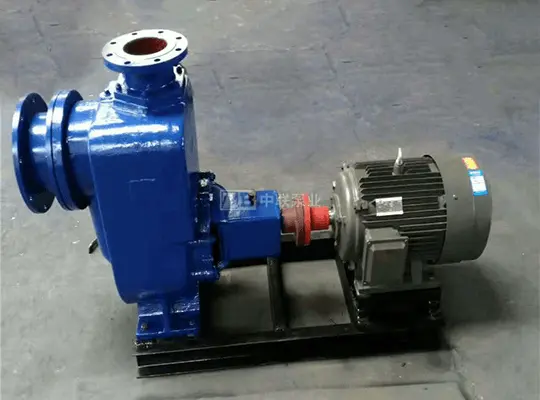
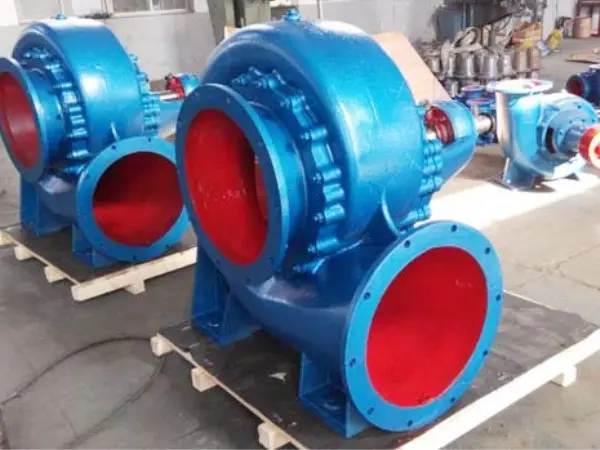
The ZX horizontal clear-water self-priming pump features a unique hydraulic design. The impeller is housed in a separate impeller chamber, which is connected to the pressurized water chamber. As the impeller rotates, it generates a strong axial vortex within the pump, creating a vacuum at the inlet and producing head pressure at the outlet. Consequently, the liquid can be discharged smoothly from the pressurized water chamber, ensuring that the pump’s flow passages remain completely unobstructed—achieving performance unmatched by other self-priming pumps. This pump is widely applicable to municipal water supply projects, light industry, papermaking, textiles, food processing, and more.
The ZX-type clear-water self-priming pump features a unique hydraulic design. The impeller is housed in a separate impeller chamber, which is connected to the pressurized water chamber. As the impeller rotates, it generates a strong axial vortex within the pump, creating a vacuum at the inlet and producing head pressure at the outlet. Consequently, the liquid can be discharged smoothly from the pressurized water chamber, ensuring that the pump’s flow passages remain completely unobstructed—a feature unmatched by other self-priming pumps. This pump is widely applicable to various industries, including municipal water supply projects, light industry, papermaking, textiles, food processing, chemical engineering, power generation, petroleum, mining, and aquaculture in rivers and ponds. It is currently considered the ideal self-priming pump for conveying media such as liquids, fibers, and slurries in China.
Product Parameters
Parameter Range and Model Designations for ZX Horizontal Clear Water Self-Priming Pumps:
Flow rate: 3–350 m³/h
Head: 12–80 m
Model Description: 25ZX3.2-20
25—Pump inlet diameter
ZX—Clear Water Self-Priming Pump
3.2—Pump design point flow rate
20—Pump design point head
Introduction to the structural features of the ZX-type clear water self-priming pump:
Working Principle and Structural Description of the ZX Horizontal Clear Water Self-Priming Pump:
ZX horizontal self-priming pumps all adopt a pump body structure with axial return flow. The pump body consists of an suction chamber, a liquid storage chamber, a volute chamber, return flow ports, and a gas-liquid separation chamber. After the pump is started normally, the impeller draws in both the liquid stored in the suction chamber and the air from the suction pipeline, thoroughly mixing them within the impeller. Under the action of centrifugal force, the liquid entrains the gas and flows toward the outer edge of the volute, forming a white foam band of a certain thickness and a high-speed rotating liquid ring at the impeller’s outer periphery. The gas-liquid mixture then passes through a diffuser tube into the gas-liquid separation chamber. At this point, due to the sudden decrease in flow velocity, the lighter gas is separated from the gas-liquid mixture. The gas continues to rise and exit through the pump’s discharge port. The degassed liquid returns to the liquid storage chamber and, via the return ports, re-enters the impeller, where it once again mixes with the gas drawn in from the suction pipeline. Under the high-speed rotation of the impeller, the liquid flows outward toward the impeller’s outer edge once more... As this process repeats continuously, the amount of air in the suction pipeline gradually decreases until all the air is exhausted, completing the self-priming process and enabling the pump to enter normal operation.
Some pump bearing housings do not yet have cooling chambers at their bases. When the bearing overheats and its temperature rises above 70℃, cooling liquid can be injected through any one of the cooling liquid pipe fittings located at the cooling chamber to initiate circulating cooling. The sealing mechanism inside the pump that prevents fluid leakage from high-pressure areas to low-pressure areas consists of front and rear sealing rings. The front sealing ring is mounted on the pump body, while the rear sealing ring is mounted on the bearing housing. After prolonged operation, when the sealing rings wear down to a certain extent and begin to affect the pump’s efficiency and self-priming performance, they should be replaced.
The ZX horizontal self-priming centrifugal pump boasts advantages such as a compact structure, convenient operation, smooth running, easy maintenance, high efficiency, long service life, and strong self-priming capability. There is no need to install a foot valve in the pipeline; before starting operation, it suffices to ensure that the pump body contains a sufficient amount of priming liquid. As a result, the self-priming centrifugal pump simplifies the piping system and improves working conditions. The basic structure of the ZX clear-water self-priming pump consists of a pump, an electric motor, and a base. The pump itself comprises components such as an impeller, a shaft sleeve, a pump shaft, and sealing elements. The sealing mechanism employed is a mechanical seal.
Scope of application:
Suitable for urban environmental protection, construction, fire protection, chemical industry, pharmaceuticals, dyeing and printing, brewing, power generation, electroplating, papermaking, petroleum, mining, equipment cooling, oil tanker unloading, and more.
Suitable for clean water, seawater, chemical media liquids containing acids and alkalis, and general paste-like slurries (medium viscosity ≤ 100 cP, solid content up to 30% or less).
Equipped with a rocker-arm nozzle, it can also spray water into the air and break it down into fine mist droplets, making it an excellent tool for pesticide application, nurseries, orchards, and tea plantations.
It can be used in combination with filter presses of any model and specification, serving as the ideal matching pump for feeding slurry into the filter press for pressure filtration.
1. When the pump is directly coupled to the motor, attention should be paid to the coaxial alignment between the pump shaft and the motor’s output shaft. The accuracy of pump installation significantly affects the smooth operation of the pump.
It has a significant impact on both performance and service life; therefore, careful and meticulous installation and calibration are essential.
2. The pump coupling must be securely tightened with a nut and then locked to prevent the nut from loosening. Otherwise, the impeller may shift, leading to mechanical failure.
3. To ensure that the pump casing can maintain a certain amount of stored liquid, thereby achieving better self-priming capability and preventing dry friction in the mechanical seal, it is essential to ensure that the pump...
The inlet is above the pump shaft centerline.
4. When installing the suction piping, please note:
a. The installation height of the suction inlet must not exceed 5 meters. When conditions permit, the installation height of the suction inlet should be as low as possible below the lowest water level in the pool, and the length of the suction pipe should be kept as short as possible with as few bends as possible. This helps shorten the self-priming time and enhance the self-priming performance.
b. Valves, flanges, and other components in the suction line must be tightly sealed to prevent air leakage or liquid seepage; in other words, there must be no air leaks in the suction line.
c. Solid particles and other debris should be prevented from being sucked into the pump body; therefore, a filter should be installed on the suction pipeline. The effective flow area of the filter should be 2 to 3 times the cross-sectional area of the suction pipe, and the filter should be inspected regularly.
d. The suction and discharge pipelines should each have their own supports; the pump body itself is not allowed to bear the load of the pipelines.
5. During installation, the static grounding resistance of the pump and its piping should meet the specified requirements.
6. During installation, carefully check the pump casing and pipelines for any foreign objects such as stones or iron sand.
7. Adjust the installation clearance and coaxiality of the pump coupling and the motor coupling. The allowable deviation in misalignment is 0.1 millimeter. The height difference between the pump shaft and the motor shaft can be adjusted by placing copper or iron shims under the base feet.
8. After the unit has been running in actual operation for 3-4 hours, perform a final inspection. If no adverse phenomena are observed, the installation can be considered satisfactory. During the trial run, the temperature of the bearings should be monitored; the temperature of the bearing housing should not exceed 70℃.
9. For pump bearing housings equipped with cooling chamber devices, the cooling water connection is designed to accommodate a rubber or plastic hose with an inner diameter of Φ12. The thread size is M12×1.75.
10. If a check valve is installed on the pump’s discharge pipeline and fails to allow the pump to smoothly expel gas during self-priming, a small vent pipe and valve should be added at the pump’s discharge outlet.
Use of the ZX Horizontal Clear Water Self-Priming Pump:
(1) Pre-startup preparation and inspection work:
1. This series of self-priming pumps is lubricated with high-quality calcium-based grease or No. 10 machine oil, depending on the pump’s operating conditions. For pumps lubricated with grease, regularly add more grease into the bearing housing. For pumps lubricated with machine oil, if the oil level is insufficient, replenish it accordingly.
2. Check whether the liquid level inside the pump casing is higher than the upper edge of the impeller. If the liquid level is insufficient, you can directly add liquid into the pump body through the filling port on the pump casing. Do not start the pump if the liquid level is inadequate; otherwise, the pump may fail to operate properly and the mechanical seal could easily be damaged.
3. Check whether the rotating parts of the pump are stuck or experiencing magnetic interference.
4. Check whether the nuts at the pump base and all connection points are loose.
5. Check the coaxiality and parallelism between the pump shaft and the motor spindle.
6. Check whether the inlet pipeline is leaking. If there is a leak, it must be eliminated.
7. Open the valve on the suction line. Slightly open (but not fully open) the outlet control valve.
(2) Starting and Operation:
1. Briefly activate the self-priming pump and ensure that the pump shaft is rotating in the correct direction.
2. Pay attention to whether there are any unusual noises or vibrations during rotation.
3. Pay attention to the readings on the pressure gauge and vacuum gauge. After starting the pump, once the readings on the pressure gauge and vacuum gauge stabilize following a period of fluctuation, it indicates that the pump has been primed with liquid and has entered normal operation.
4. Before the pump enters normal fluid delivery operation—that is, during the self-priming process—special attention should be paid to any rise in water temperature inside the pump. If this process takes too long and the water temperature inside the pump becomes excessively high, stop the pump immediately and investigate the cause.
5. If the liquid temperature inside the pump is too high, causing difficulties with self-priming, you can temporarily stop the pump. Use the discharge pipeline to allow the liquid to flow backward into the pump or directly add liquid into the pump through the liquid-injection port on the pump body, thereby cooling down the liquid inside the pump. Then, restart the pump.
6. If the pump experiences severe vibration and abnormal noise during operation, it could be due to cavitation. There are two main causes of cavitation: First, the flow velocity in the inlet pipe is too high; second, the suction lift is excessively high. When the flow velocity is too high, you can adjust the outlet control valve to increase the pressure gauge reading. If there is a blockage in the inlet pipeline, it should be promptly removed. If the suction lift is too high, you can appropriately lower the installation height of the pump.
7. If the pump stops unexpectedly during operation and needs to be restarted, the outlet control valve should be slightly open (not fully closed). This not only facilitates the discharge of gas from the outlet during the self-priming process but also ensures that the pump starts under a lighter load.
8. Pay attention to checking the pipeline system for any leaks.
(3) Pump shutdown:
1. First, the gate valve on the discharge pipeline must be closed.
2. Stop the pump from rotating.
3. During the cold season, the liquid stored in the pump body and the water in the bearing housing cooling chamber should be drained to prevent freezing and cracking of the components.
Friendly reminder: For more performance parameters of the ZX horizontal clear water self-priming centrifugal pump, please click → [Water Pump Selection] Page query
Why choose us?
Changsha Zhonghlian Pump Industry Co., Ltd. was founded in 1989 and was independently established after the restructuring of Changsha Water Pump Factory. It is a comprehensive national high-tech enterprise integrating design, research and development, manufacturing, and service. The company was listed on the Hunan Provincial Equity Exchange on December 31, 2019, with the abbreviation "Zhonghlian Pump Industry" and the equity code: 600275HN. It is currently a key backbone enterprise in China's centrifugal pump industry and one of the major professional manufacturers of multi-stage pumps in the country. The headquarters is located in Changsha City, Hunan Province, a historical and cultural city in China.
41000m²
Square meters of land area
100%
100% factory pass rate
41000m²
Square meters of land area
100%
100% factory pass rate
Q
What is your typical delivery time?
A
Models in stock can be shipped the next day at the latest. All others are custom-made, with lead times generally ranging from 7 to 90 days depending on the product size and project specifics. Please contact our sales manager for details: 0731-88632200 。
Q
Do you have centrifugal pumps in stock?
A
Centrifugal pumps come in numerous models and configurations. Except for a small number of high-volume, standard models that are in stock, the vast majority are not stocked and are customized products. We need to select a pump based on your site's flow rate, head, media temperature, pH value, and installation conditions, etc., to determine the pump model and configuration before we can submit an order to the factory for production.
Q
What information should I provide when requesting a quote?
A
Generally, to obtain an accurate quotation, we recommend providing us with the following information: pump flow rate, head, on-site operating voltage and frequency, temperature, pH value, and solid particle content of the fluid being conveyed, and on-site installation conditions (horizontal or vertical installation), etc.
If you are not sure, don't worry, our business managers will assist you in determining this.
Q
What products do you mainly produce?
A
Zhonglian Pump Industry manufactures various large industrial centrifugal pumps. Main products include: self-balancing multi-stage pumps, multi-stage centrifugal pumps, single-stage centrifugal pumps, split-case pumps, chemical pumps, submersible pumps, pipeline pumps, long-shaft pumps, condensate pumps, etc.
Q
Could you help me with the selection?
A
Certainly! If the water pump model is not selected accurately, there will be big problems. If you choose a smaller one, it won't meet your needs; if you choose a larger one, it will waste electricity and fuel, increasing your costs.
Q
Why is it so slow to get a price quote?
A
Because centrifugal pumps are non-standard customized products with many models, the price range is also very large. Even for the same model, the price difference is also very large due to different materials and configurations. Taking the most common water pump accessory—the impeller—as an example, the price of a stainless steel impeller is several times that of a cast iron impeller.
Therefore, we need to clarify the relevant information to give you an accurate price. Normally, if you provide relatively comprehensive information, we can quote within 5 minutes.