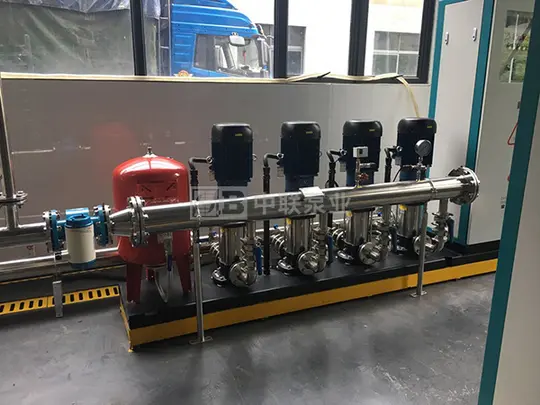
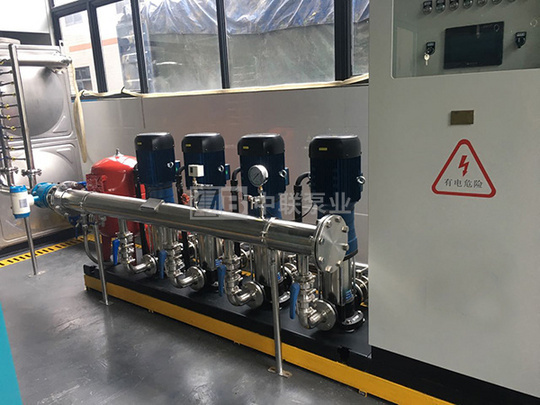
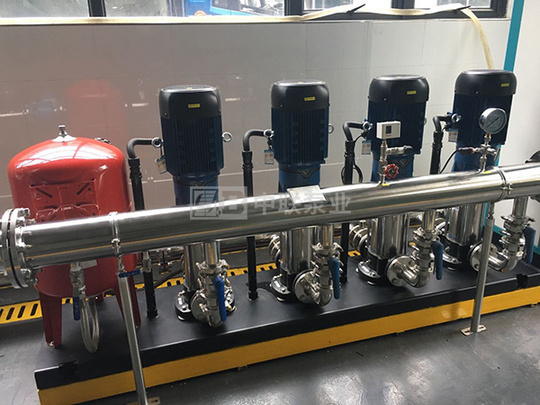
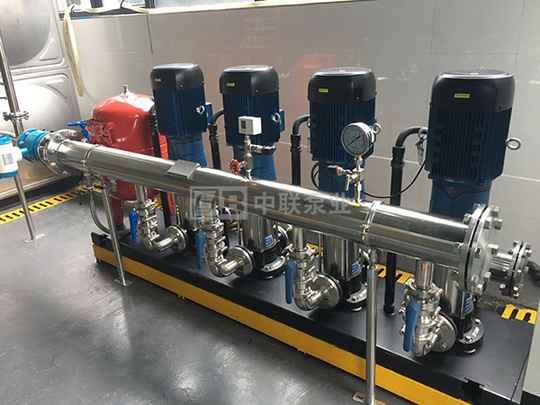
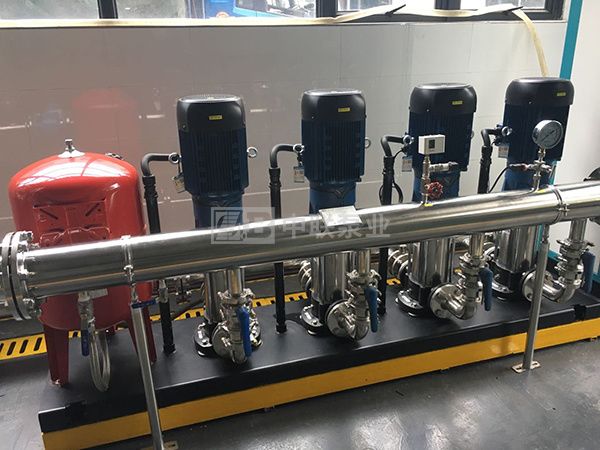
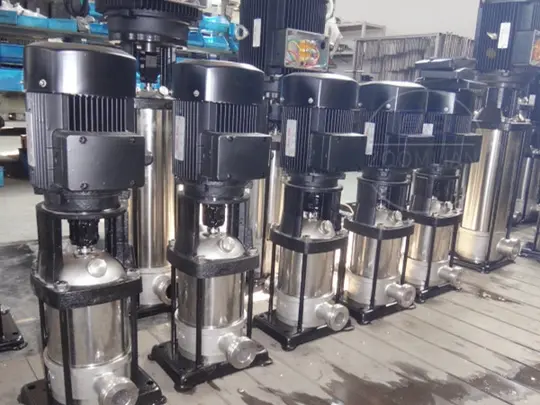
Secondary pressurized water supply refers to a method of boosting water pressure—beyond relying solely on gravity—by using techniques such as air pressure to deliver water to higher elevations. This approach breaks away from the traditional high-water-tower model, enabling direct water delivery from lower to higher locations. Secondary pressurized water supply equipment generally includes either non-negative-pressure water supply systems or variable-frequency constant-pressure water supply systems, both of which can be used for secondary pressurized water supply.
Secondary pressurization water supply equipment refers to systems that, in addition to relying on gravity, use methods such as air pressure to increase water pressure and deliver water to higher elevations. This approach breaks away from the traditional high-water-tower model, enabling direct water supply from lower to higher locations. Generally, secondary pressurization water supply equipment refers to either non-negative-pressure water supply systems or variable-frequency constant-pressure water supply systems, both of which can be used for secondary pressurization water supply.
Product Parameters
Features of secondary pressurized water supply equipment:
The variable-frequency constant-pressure water supply equipment is a new type of energy-saving water supply system that integrates advanced microcomputer control technology with motor-driven pumps and variable-frequency drives, forming a high-tech, electromechanical integrated energy-saving water supply device. This equipment uses the water pressure at the pump’s outlet (or the user’s water flow rate) as the setpoint parameter. A microcomputer automatically controls the output frequency of the variable-frequency drive, thereby adjusting the rotational speed of the pump motor and achieving closed-loop regulation of the water pressure in the user’s pipeline network. As a result, the water supply system maintains a constant pressure automatically at the preset value: when water consumption increases, the frequency rises and the pump’s rotational speed accelerates; when water consumption decreases, the frequency falls and the pump’s rotational speed slows down. In this way, the entire user pipeline network is ensured to have sufficient water pressure (consistent with the user’s set pressure) and adequate water volume (which varies according to the user’s actual water usage). The non-negative-pressure water supply equipment uses the municipal water network as its water source and fully leverages the existing pressure in the municipal network to create a closed, continuous, relay-based pressurization water supply system. It boasts excellent energy-saving performance and eliminates secondary water contamination, representing a development and extension of variable-frequency constant-pressure water supply systems. By directly superimposing pressure on top of the municipal network’s existing pressure, this system saves energy while also offering numerous advantages, including being fully enclosed, easy to maintain, requiring minimal space, quick to install, pollution-free, and highly reliable in operation.
Secondary pressurized water supply equipment operating mode:
Secondary water supply is a variable-frequency water supply system that further boosts water pressure on top of the existing network’s initial pressure. This equipment represents an ideal energy-saving water supply solution. It can be directly connected to the municipal water supply network, enabling high-rise buildings to overcome the limitations imposed by network pressure and ensuring that the water supply meets user demands without causing any adverse effects on the municipal water network. Based on the pressure of the municipal water supply network, this secondary water supply system operates by directly boosting the pressure without creating negative pressure, thereby saving energy. Moreover, the equipment incorporates advanced fully automatic intelligent pressure-boosting technology, under-pressure adjustment technology, constant-pressure towerless water supply systems, fully enclosed pressurized flow stabilization compensation technology, and boasts numerous advantages such as zero pollution, compact footprint, rapid installation, reliable operation, and easy maintenance. Additionally, this towerless water supply system delivers stable water pressure with minimal fluctuations, and it does not affect the pressure in adjacent water networks.
Secondary water supply equipment is widely applicable to various types of water supply systems in buildings. This equipment features advanced technology, rational operation, and a broad range of water source compatibility—suitable for surface or underground reservoirs, deep wells, and other water sources. It can be used directly to boost pressure in the water distribution network, offering significant energy-saving, hygienic, and scientific benefits. The system boasts a high degree of automation; pressure settings can be customized as needed, and frequency conversion speed regulation is controlled by a PID controller and a programmable logic controller. Multiple pumps are employed, each started and stopped smoothly via soft starters, ensuring precise switching, stable water pressure, and reliable operation. This approach reduces power grid surges, extends the service life of electrical and mechanical components, and achieves remarkable energy savings because the pump units operate at their most efficient performance levels.
Constant Flow Compensator and Vacuum Inhibitor Control Modes
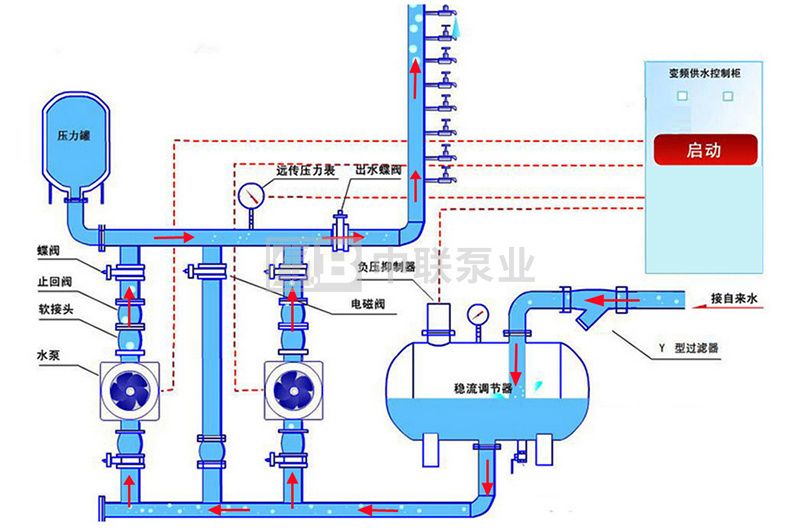
When the municipal water supply network cannot meet demand or when a user’s water consumption exceeds the capacity of the municipal network, the vacuum suppressor opens, allowing air to enter the constant-flow compensator. This transforms the originally sealed compensator into a non-flow tank, thereby preventing the generation of negative pressure. Additionally, a liquid-level control is installed within the constant-flow compensator; when the liquid level drops below the low-level threshold, the pump stops operating.
Self-regulating current-limiting mode
When the municipal water supply network cannot meet demand or when a user’s water consumption exceeds the capacity of the municipal network, the system responds by adjusting the frequency converter based on feedback from pressure sensors, thereby limiting the pump’s water intake and preventing overuse. Once the municipal water supply network resumes meeting demand, the system returns to normal operation.
Pressure control point method
When the municipal water supply network cannot meet demand or when a user’s water consumption exceeds the capacity of the municipal water supply network, the variable-flow constant-pressure water pump will be directly started. Once the water supply meets the required standards, the system will return to normal operation.
The principle of secondary pressurized water supply equipment:
The secondary pressurization water supply equipment can set the water supply pressure according to user requirements. If the water supply pressure in the municipal pipeline network exceeds the set pressure, the pump unit will shut down, and tap water can directly supply users through the connecting pipeline. When the water supply pressure in the municipal pipeline network falls below the set pressure, the equipment automatically enters a relay-pressure-increasing operating mode. The equipment’s closed-loop control system consists of pressure sensors, pumps, and a constant-pressure variable-frequency control cabinet. As water consumption changes, the system continuously adjusts the pump speed and the number of pumps put into operation to maintain a stable water supply pressure. Since the flow regulator is a sealed container, when the municipal pipeline network can meet the water demand, this equipment acts as a buffer between the pipeline network and the water supply equipment, thereby eliminating the pulsating effects of the pump unit on the pipeline network. When the water supply from the municipal pipeline network is insufficient, the flow regulator functions as a flow-adjusting device, alleviating the shortage of water flow during peak demand periods. A network protector is installed on the flow regulator: when the pressure inside the tank is higher than the external pressure, the network protector closes, allowing the pump unit to superimpose the original pressure from the municipal pipeline network for constant-pressure water supply. When the pressure inside the tank balances with the external pressure, the network protector opens and connects to the outside atmosphere, preventing negative pressure from forming and ensuring the safety of the municipal pipeline network as well as normal water supply for other users. In the event of a water supply interruption in the municipal pipeline network, the equipment automatically stops operating; once the water supply is restored, the equipment automatically restarts. During a power outage, the pump unit ceases operation, and tap water can directly enter the user’s pipeline network through the connecting pipe. Upon restoration of power, the pump unit automatically restarts and resumes normal water supply.
Secondary water supply equipment is typically installed above ground or in basements. For organizations already connected to a municipal water supply, this equipment can regulate peak water demand and increase water pressure, ensuring sufficient water supply for large areas and high-rise buildings during peak usage periods. For organizations, factories, or villages that do not have access to a municipal water supply, simply connecting this equipment to a water source and power supply will provide a stable water flow and pressure, fully meeting their water needs. The secondary water supply equipment consists of three main components: an air-pressure tank, a water pump, and an electrical control system. Its outstanding advantages include the elimination of the need to build a water tower, low capital investment, minimal land use, flexible configuration, and rapid installation and commissioning. It features automatic air-water regulation, automatic operation, energy efficiency, and seamless integration with the municipal water supply. Even after a power outage, the system can continue to supply water, and once properly configured, it requires no ongoing supervision. This equipment is widely used in industrial enterprises, vertical residential complexes without towers, and rural areas for production, daily life, and work-related water supply. It is suitable for sites serving up to 5,000 households, with a daily water supply capacity of up to 3,000 m³, and capable of delivering water to heights exceeding 100 meters.
The secondary water supply equipment employs pneumatic pressurized water supply. It uses a sealed tank, leveraging the high-pressure air-water pressure inside the tank to achieve water delivery. Specifically, the water pump forces water into the tank through a check valve, compressing the gas inside and gradually increasing the pressure. When the pressure reaches the preset upper limit, the electrical contact pressure gauge, via the control cabinet, automatically starts the pump continuously. The water pressure within the equipment exceeds the pressure in the external distribution network, enabling automatic water delivery to the supply network. As the water level in the tank drops and the gas pressure inside the variable-frequency constant-pressure tank decreases to the preset lower limit, the electrical contact pressure gauge, again via the control cabinet, triggers the pump to restart. This cycle repeats continuously, ensuring a steady water supply. When the gas volume inside the tank becomes insufficient, the air replenishment valve automatically adds more gas.
Friendly reminder: For performance parameters, please refer directly to the pump selection page.
Why choose us?
Changsha Zhonghlian Pump Industry Co., Ltd. was founded in 1989 and was independently established after the restructuring of Changsha Water Pump Factory. It is a comprehensive national high-tech enterprise integrating design, research and development, manufacturing, and service. The company was listed on the Hunan Provincial Equity Exchange on December 31, 2019, with the abbreviation "Zhonghlian Pump Industry" and the equity code: 600275HN. It is currently a key backbone enterprise in China's centrifugal pump industry and one of the major professional manufacturers of multi-stage pumps in the country. The headquarters is located in Changsha City, Hunan Province, a historical and cultural city in China.
41000m²
Square meters of land area
100%
100% factory pass rate
41000m²
Square meters of land area
100%
100% factory pass rate
Q
What is your typical delivery time?
A
Models in stock can be shipped the next day at the latest. All others are custom-made, with lead times generally ranging from 7 to 90 days depending on the product size and project specifics. Please contact our sales manager for details: 0731-88632200 。
Q
Do you have centrifugal pumps in stock?
A
Centrifugal pumps come in numerous models and configurations. Except for a small number of high-volume, standard models that are in stock, the vast majority are not stocked and are customized products. We need to select a pump based on your site's flow rate, head, media temperature, pH value, and installation conditions, etc., to determine the pump model and configuration before we can submit an order to the factory for production.
Q
What information should I provide when requesting a quote?
A
Generally, to obtain an accurate quotation, we recommend providing us with the following information: pump flow rate, head, on-site operating voltage and frequency, temperature, pH value, and solid particle content of the fluid being conveyed, and on-site installation conditions (horizontal or vertical installation), etc.
If you are not sure, don't worry, our business managers will assist you in determining this.
Q
What products do you mainly produce?
A
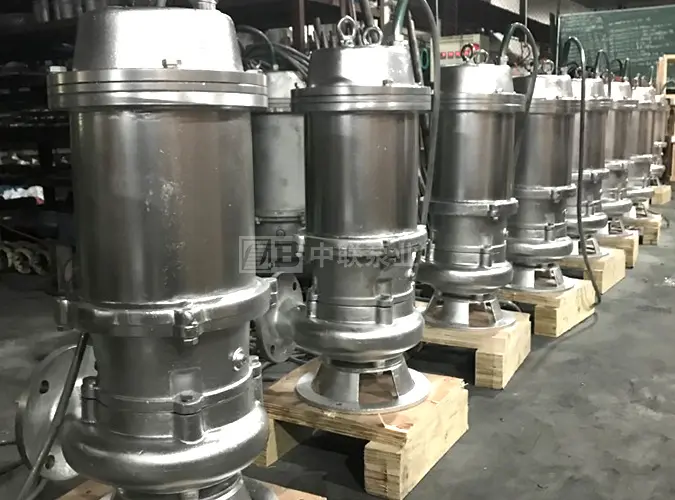
Zhonglian Pump Industry manufactures various large industrial centrifugal pumps. Main products include: self-balancing multi-stage pumps, multi-stage centrifugal pumps, single-stage centrifugal pumps, split-case pumps, chemical pumps, submersible pumps, pipeline pumps, long-shaft pumps, condensate pumps, etc.
Q
Could you help me with the selection?
A
Certainly! If the water pump model is not selected accurately, there will be big problems. If you choose a smaller one, it won't meet your needs; if you choose a larger one, it will waste electricity and fuel, increasing your costs.
Q
Why is it so slow to get a price quote?
A
Because centrifugal pumps are non-standard customized products with many models, the price range is also very large. Even for the same model, the price difference is also very large due to different materials and configurations. Taking the most common water pump accessory—the impeller—as an example, the price of a stainless steel impeller is several times that of a cast iron impeller.
Therefore, we need to clarify the relevant information to give you an accurate price. Normally, if you provide relatively comprehensive information, we can quote within 5 minutes.