

-
Product
-
-
Service Policy
-
-
Blog
-
Join Us
Having 26 series -312 varieties - over 1000 pump models
Focused on water pump research and development manufacturing for 36 years
Free training for operation and maintenance personnel/free installation guidance/free provision of installation drawings
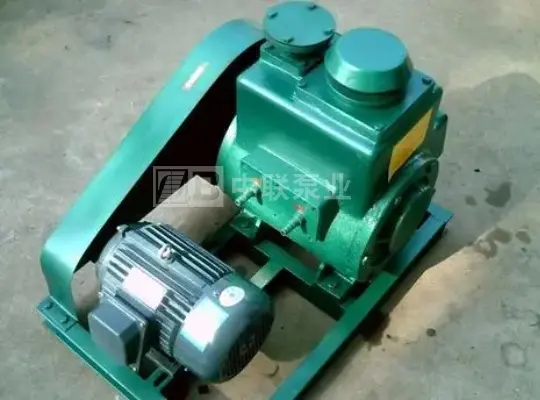
2XZ Double-Stage Rotary Vane Vacuum Pump
Pumping rate: 0.015–1.8 m³/min
Vacuum degree: 6.7 × 10⁻⁶ MPa
Efficiency: 0.12-2.2kw
Rotational speed: 1400rpm
Pump weight: 15-98kg
Price: 29,000–29,800
The 2XZ rotary vane vacuum pump features a two-stage direct-coupling design, with the pump directly connected to the motor via a shaft. It boasts high rotational speed, a compact size, and a streamlined, space-saving structure, making it highly convenient for mobile operations. This pump is suitable for applications including the manufacture of electrical vacuum devices, thermos flask production, vacuum welding, printing, thermoforming, refrigeration equipment repair, and integration with instruments and meters.
Hotline:
Vacuum pump
Horizontal Single-Stage Fire Pump
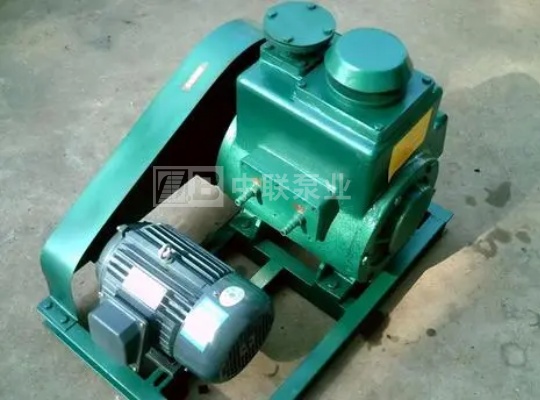
Product Parameters
Meaning of the Model Designation for 2XZ Double-Stage Rotary Vane Vacuum Pumps
For example: 2XZ8
2 - Indicates a two-stage pump
X—Indicates a rotary vane vacuum pump
Z—Indicates the pump is coupled with the motor.
8 - Indicates the pumping speed per second
Product Applications of the 2XZ Double-Stage Rotary Vane Vacuum Pump
1. The 2XZ rotary vane vacuum pump is a basic piece of equipment used to extract gases from specially sealed containers, thereby achieving a certain degree of vacuum within those containers. Due to the rapid advancement of modern science and technology, vacuum pumps are now widely used in various scientific fields as well as in a broad range of enterprises and institutions. They can be employed by research institutes, colleges and universities, and industrial and mining enterprises in sectors such as metallurgy, chemical engineering, light industry, petroleum, medical care, pharmaceuticals, dyeing and printing, electrical appliances, electron vacuum technology, semiconductors, food processing, atomic energy, textiles, and other related fields for research, production, and teaching purposes.
2. Since rotary vane vacuum pumps are made of ferrous metals and are relatively precise, with all components of the pump closely interconnected, they are not suitable for pumping gases that are excessively oxygen-rich, toxic, explosive, corrosive to ferrous metals, or capable of chemically reacting with vacuum oil. Furthermore, these pumps should not be used as compressors or transfer pumps. However, pumps equipped with a gas ballast device can handle certain condensable vapors.
3. Rotary vane vacuum pumps can be used to directly achieve vacuum levels below 10^-3 Torr, as well as in conjunction with other vacuum operations.
4. Rotary vane vacuum pumps are generally used in environments with room temperatures no lower than 5°C and relative humidity no higher than 90%.
5. The 2XZ rotary vane vacuum pump is one of the fundamental pieces of equipment used for evacuating gases from sealed containers. It can operate independently or serve as a forepump for booster pumps, diffusion pumps, molecular pumps, and other similar devices; it can also function as a backing pump or a pre-pump for titanium pumps. This pump finds applications in the manufacturing of electrical vacuum components, thermos flask production, vacuum welding, printing, thermoforming, refrigeration equipment repair, and instrumentation support. Due to its advantages—such as compact size, light weight, and low noise—it is particularly well-suited for laboratory use.
6. Under ambient temperatures ranging from 5 to 40°C and with an inlet pressure below 1.3 × 10³ Pa, continuous operation is permitted. When the relative humidity of the gas being pumped exceeds 90%, the gas ballast valve should be opened.
7. The intake port must remain continuously unobstructed, and the engine may not run under atmospheric conditions for more than one minute.
8. Not suitable for extracting gases that are corrosive to metals, chemically reactive with pump oil, contain particulate dust, have excessively high oxygen content, are explosive, or are toxic.
Product Features of the 2XZ Double-Stage Rotary Vane Vacuum Pump
Pumping speed: 0.15–15 L/s (liters per second) | Ultimate vacuum: ≤6×10⁻² Pa (Pascals)
Ultimate vacuum: ≤1.3 Pa (Pascal) | Gas type: Clean, dry air at room temperature without any other mixtures; air containing dust or moisture is strictly prohibited.
Work requirements: When the inlet pressure exceeds 6,500 Pa, the continuous operating time must not exceed 3 minutes to prevent oil spray from causing pump damage.
Work requirements: Under conditions where the inlet pressure is less than 1330 Pa, continuous operation for extended periods is permitted.
Ambient temperature: The 2XZ rotary vane vacuum pump is generally used in environments with an ambient temperature no lower than 5℃ and a relative humidity no higher than 90%.
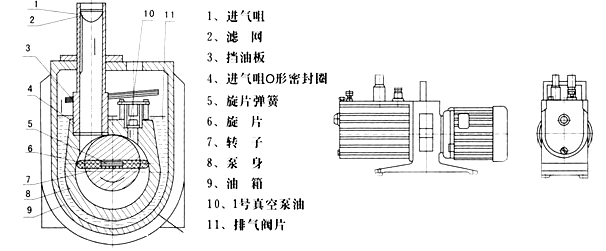
The 2XZ two-stage rotary vane vacuum pump is a positive-displacement pump. It operates by means of rotating vanes within the pump chamber, which continuously divide the chamber into two distinct zones whose volumes alternately expand and contract, thereby drawing in, compressing, and exhausting gas to achieve vacuum in the container. This pump consists of two working chambers connected in series, rotating in the same direction at the same speed. The gas to be pumped is drawn into the chamber of the front-stage pump, compressed, and then discharged either directly into the rear-stage pump chamber or routed through the rear-stage pump for further compression and eventual discharge outside the pump via a defogger (exhaust stack).
1. A pump is the fundamental equipment for achieving a vacuum; it can operate independently or serve as a preliminary pump and pre-pump for various high-vacuum systems.
2. The pump’s intake port must not be left continuously open to the atmosphere for more than three minutes.
3. The pump is not suitable for extracting gases that are corrosive to metals, chemically reactive with the pump oil, contain particulate dust, have excessively high oxygen content, or are explosive.
4. The pump must not be used as a compression pump or a delivery pump.
5. Pump operating environment: The pump is permitted to operate continuously for extended periods under the following conditions: ambient temperature between 5℃ and 40℃, relative humidity no greater than 90%, and inlet pressure below 1333 Pa.
6. When connecting the power supply, follow the wiring instructions specified on the motor nameplate. Note that the motor’s rotation direction must be consistent with the direction indicated by the arrow on the mounting bracket.
7. For pipelines connected to continuously evacuated vessels, the pipe diameter should be no smaller than the diameter of the pump’s inlet port. The pipeline should also be short with as few bends as possible, and care should be taken to prevent leaks in the pipeline.
8. Before each startup, pay close attention to checking the oil level; it is advisable to add oil until it reaches 4/5 of the height of the oil-level glass when the pump is stopped.
9. Use clean SY1634-70 No. 1 vacuum pump oil for pumping.
10. The pump can be started once under either atmospheric pressure or any vacuum level. If it’s difficult to start, you can remove the air intake pipe cap to initiate the start-up, then put it into operation afterward.
Model | Vacuuming Speed (L/S) | Ultimate vacuum (Pa) | Rotational speed (rpm) | Work Voltage (V) | Motor Power (kw) | Air intake Diameter (mm) | Oil consumption (L) | Pump oil Temperature rise (℃) | External dimensions | Total weight (kg) | |||
Gas seal valve | Gas seal on | long | Wide | High | |||||||||
XZ-0.5 | 0.5 | 10 | 1400 | 220 | 0.09 | 7 | 0.18 | >40 | 225 | 110 | 220 | 7.2 | |
XZ-1 | 1 | 10 | 1400 | 220 | 0.12 | 10 | 0.25 | >40 | 275 | 110 | 220 | 7.5 | |
2XZ-0.25 | 0.25 | 6.7 × 10⁻¹ | 220 | 0.12 | 10 | 0.3 | >40 | 440 | 125 | 224 | 11 | ||
2XZ-0.5 | 0.5 | 6.7 × 10⁻² | 1.33 | 1400 | 220 | 0.18 | 13 | 0.42 | 445 | 125 | 256 | 13 | |
2XZ-1 | 1 | 6.7 × 10⁻² | 1.33 | 1400 | 220 | 0.25 | 19 | 0.4 | >40 | 445 | 125 | 256 | 14 |
2XZ-2 | 2 | 6.7 × 10⁻² | 1.33 | 1400 | 380/220 | 0.37 | 19 | 0.48 | 478 | 148 | 277 | 20 | |
2XZ-4 | 4 | 6.7 × 10⁻² | 1.33 | 1400 | 380/220 | 0.55 | 30 | 0.55 | 518 | 148 | 277 | 22 | |
2XZ-8 | 8 | 6.7 × 10⁻² | 1.33 | 1400 | 380 | 1.1 | 30 | 0.7 | >50 | 575 | 185 | 315 | 55 |
2XZ-15 | 15 | 6.7 × 10⁻² | 1.33 | 1400 | 380 | 1.5 | 40 | 0.8 | >70 | 578 | 185 | 315 | 55 |
Operating Instructions
1. Check the oil level; it is advisable to fill the oil up to the center of the oil-level indicator when the pump is stopped. If the oil level is too low, the oil will fail to provide an effective seal for the exhaust valve, thereby compromising the vacuum degree. Conversely, if the oil level is too high, oil may be sprayed out during startup when the pump is connected to the atmosphere. During operation, a slight rise in the oil level is normal. Use clean vacuum pump oil of the specified grade, and add it through the oil-filling port. After filling, be sure to tighten the screw plug. It is recommended to filter the oil beforehand to prevent foreign particles from entering and clogging the oil passages.
2. The 2XZ rotary vane vacuum pump can be started in one go, either with atmospheric pressure or at any vacuum level. If an electromagnetic valve is installed at the pump inlet, it should operate simultaneously with the pump.
3. When the ambient temperature is too high, the oil temperature rises, its viscosity decreases, and its saturation vapor pressure increases, which can lead to a slight drop in the ultimate vacuum—especially the total pressure measured by a thermocouple gauge. The ultimate vacuum can be improved by enhancing ventilation and heat dissipation or by improving the performance of the pump oil.
4. The ultimate vacuum of a 2XZ rotary vane vacuum pump shall be determined using a compression-type mercury vacuum gauge. Provided that the gauge has been adequately pre-evacuated and calibrated, the pump temperature has stabilized, and the pump inlet is directly connected to the gauge, the pump will reach its ultimate vacuum within 30 minutes of operation. The value measured by the total pressure gauge is affected by errors in the pump oil, the vacuum gauge itself, and the connecting tubing; sometimes these errors can be quite significant and thus the reading should be used only as a reference.
5. If the relative humidity is relatively high or the gas being pumped contains a significant amount of condensable vapor, after connecting the pump to the vessel being evacuated, it is advisable to open the gas ballast valve and run the pump for 20 to 40 minutes before closing the valve. Before stopping the pump, you can open the gas ballast valve and let the pump run unloaded for 30 minutes to extend the service life of the pump oil.
6. Selection of Oil for 2XZ Rotary Vane Vacuum Pumps: The viscosity of the pump oil affects both the starting power and the ultimate vacuum of the pump. A higher viscosity is beneficial for achieving a higher vacuum level, though it results in greater starting power. The saturation vapor pressure of the oil at pump operating temperature influences the pump’s ultimate total pressure; the lower this value, the better. High-speed vacuum pump oils and No. 3 diffusion pump oils have higher viscosities and lower saturation vapor pressures than No. 1 vacuum pump oil. However, No. 3 diffusion pump oil is more expensive. The specific oil to choose should be determined based on the above information, combined with the particular requirements of your application.
(1) In general, for applications requiring a total pressure of 6 × 10⁻² Pa or higher, it is recommended to use high-speed vacuum pump oil manufactured in Shanghai. For small pumps with a capacity of less than 4 liters/second, vacuum oil No. 1 can be used as a substitute; for direct-coupled pumps with a capacity of 8 liters/second or higher, diffusion pump oil No. 3 can be used as a substitute.
(2) If the vacuum level requirement is not high and oil contamination occurs frequently, making it difficult to supply vacuum pump oil, No. 50 mechanical oil can be used as a substitute.
(3) If the ambient temperature is low, starting is difficult, and the ultimate vacuum requirement is not high, a vacuum pump oil or mechanical oil with a slightly lower viscosity than the one recommended can be used.
Why choose us?
Changsha Zhonghlian Pump Industry Co., Ltd. was founded in 1989 and was independently established after the restructuring of Changsha Water Pump Factory. It is a comprehensive national high-tech enterprise integrating design, research and development, manufacturing, and service. The company was listed on the Hunan Provincial Equity Exchange on December 31, 2019, with the abbreviation "Zhonghlian Pump Industry" and the equity code: 600275HN. It is currently a key backbone enterprise in China's centrifugal pump industry and one of the major professional manufacturers of multi-stage pumps in the country. The headquarters is located in Changsha City, Hunan Province, a historical and cultural city in China.
Square meters of land area
100% factory pass rate
Square meters of land area
100% factory pass rate
Q
What is your typical delivery time?
A
Models in stock can be shipped the next day at the latest. All others are custom-made, with lead times generally ranging from 7 to 90 days depending on the product size and project specifics. Please contact our sales manager for details: 0731-88632200 。
Q
Do you have centrifugal pumps in stock?
A
Centrifugal pumps come in numerous models and configurations. Except for a small number of high-volume, standard models that are in stock, the vast majority are not stocked and are customized products. We need to select a pump based on your site's flow rate, head, media temperature, pH value, and installation conditions, etc., to determine the pump model and configuration before we can submit an order to the factory for production.
Q
What information should I provide when requesting a quote?
A
Generally, to obtain an accurate quotation, we recommend providing us with the following information: pump flow rate, head, on-site operating voltage and frequency, temperature, pH value, and solid particle content of the fluid being conveyed, and on-site installation conditions (horizontal or vertical installation), etc.
If you are not sure, don't worry, our business managers will assist you in determining this.
Q
What products do you mainly produce?
A
Zhonglian Pump Industry manufactures various large industrial centrifugal pumps. Main products include: self-balancing multi-stage pumps, multi-stage centrifugal pumps, single-stage centrifugal pumps, split-case pumps, chemical pumps, submersible pumps, pipeline pumps, long-shaft pumps, condensate pumps, etc.
Q
Why is it so slow to get a price quote?
A
Because centrifugal pumps are non-standard customized products with many models, the price range is also very large. Even for the same model, the price difference is also very large due to different materials and configurations. Taking the most common water pump accessory—the impeller—as an example, the price of a stainless steel impeller is several times that of a cast iron impeller. Therefore, we need to clarify the relevant information to give you an accurate price. Normally, if you provide relatively comprehensive information, we can quote within 5 minutes.
Previous Page
Next Page
Previous Page
Next Page

Product message
Contact our team promptly; we are happy to help you.
*Note: Please fill in the information accurately and keep the communication open. We will contact you as soon as possible.

Hotline:
+86 0731-88632200
Export Trade/Technical Support:
+86 153-4831-2290
Head Office Email:
zoomlian@yeah.net
No. 210, Huanbao Zhong Road, Yuhua District, Changsha City, Hunan Province, Leowoju Wisdom Valley Building B, 8th Floor
Quick Navigation


Hot Products
Online Consultation
Powered by:www.300.cn Changsha SEO