Having 26 series -312 varieties - over 1000 pump models

Focused on water pump research and development manufacturing for 36 years

Free training for operation and maintenance personnel/free installation guidance/free provision of installation drawings

SZ Series Liquid Ring Vacuum Pump


classification:

Vacuum pump

keyword:

Horizontal Single-Stage Fire Pump

Product overview Product parameters Why choose us? Frequently Asked Questions

Product Overview

  The SZ series liquid-ring vacuum pumps and compressors are vacuum pumps used for extracting or compressing air and other non-corrosive, water-insoluble gases, enabling the creation of vacuum and pressure within sealed containers. The SZ liquid-ring vacuum pumps come in four models: SZ-1, SZ-2, SZ-3, and SZ-4. The maximum vacuum levels achievable by these pumps range from 86% to 95%. The maximum pressures that SZ-1 and SZ-2 can generate are between 1.0 and 1.4 kg/cm²; for SZ-3 and SZ-4, under the allowable power rating of their respective electric motors, the maximum pressure is 1.5 kg/cm². If the motor power is increased, the maximum pressure can reach 2.1 kg/cm². (Pump model designation: For example, SZ-1—S stands for liquid-ring, Z stands for vacuum pump, and 1 indicates the pump’s serial number.)

 SZ Series Liquid Ring Vacuum Pump

Product Parameters

Working principle of the SZ series liquid-ring vacuum pump:

 Working Principle of the SZ Series Liquid Ring Vacuum Pump

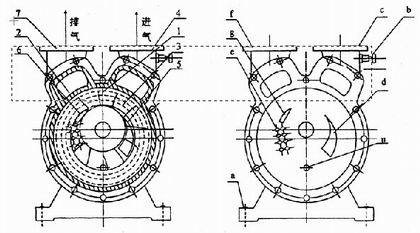
  Figure 1 Figure 2

  Diagram of a Liquid Ring Vacuum Pump and Compressor Mechanism

  1. Impeller 2. Pump body 3. Water ring 4. Inlet pipe 5. Suction port 6. Exhaust port 7. Exhaust pipe a. Base foot b. Vacuum adjustment valve c. Inlet pipe d. Suction port e. Rubber valve f. Exhaust pipe g. Exhaust port u. Inlet water port

  As shown in Figure 1, the SZ water-ring vacuum pump features an impeller ① mounted eccentrically inside the pump body ②. When starting the pump, a certain height of water is injected into the pump chamber.

  Therefore, as the impeller rotates, the water is subjected to centrifugal force, forming a rotating water ring ③ against the inner wall of the pump casing. The inner surface of the upper part of the water ring is tangent to the hub and rotates in the direction indicated by the arrow. During the first half of the rotation, the inner surface of the water ring gradually moves away from the hub, thereby creating and progressively expanding a space between the impeller blades. This allows air to be drawn in through the suction port. During the second half of the rotation, the inner surface of the water ring gradually approaches the hub, causing the volume of the space between the blades to decrease. As a result, the air trapped between the blades is compressed and expelled outward.

  Thus, as the impeller rotates one full revolution, the volume of the space between the blades changes once. The water between each pair of blades moves back and forth like a piston, and the SZ liquid-ring vacuum pump continuously draws in gas.

  Since water heats up during operation and some of it is discharged along with the gas, the SZ liquid-ring vacuum pump must be continuously supplied with cold water during operation to cool the pump and replenish the water consumed within the pump. The ideal temperature for the supplied cold water is 15°C.

  When the gas discharged by the SZ liquid-ring vacuum pump is exhaust gas, a water tank is connected to the exhaust end. After the exhaust gas and some of the water it carries are discharged into the water tank, the gas escapes through the tank’s outlet pipe, while the water flows to the bottom of the tank and then returns to the pump via a return pipe for reuse. If the circulation time becomes prolonged, the water may heat up; in such cases, it is necessary to supply a certain amount of cold water from the water tank’s supply source.

  Since water heats up during operation and some of it is discharged along with the gas, the SZ liquid-ring vacuum pump must be continuously supplied with cold water during operation to cool the pump and replenish the water consumed within it.

  When the gas discharged by the SZ liquid-ring vacuum pump is waste gas, a water tank is connected to the exhaust end. After the wastewater and some of the water carried along with it are collected in the tank, the gas exits through the tank’s outlet pipe, while the water flows down to the bottom of the tank and then returns to the pump via a return pipe for reuse. If the water circulation lasts for an extended period, the water may heat up. In such cases, it’s necessary to supply a certain amount of cold water from the tank’s water supply source.

  When the SZ liquid-ring vacuum pump is used as a compressor, a gas-water separator must be connected to the exhaust end. As the gas containing water enters the separator, it automatically separates—the gas is then routed through the separator’s outlet to the desired location, while the hot water is discharged via an automatic valve. (Since compressed gases tend to generate heat, the water exiting the pump becomes hot.) At the bottom of the separator, cold water must be continuously supplied to replenish the hot water that has been discharged, while also serving to cool the system.

Structural description of the SZ series liquid-ring vacuum pump:

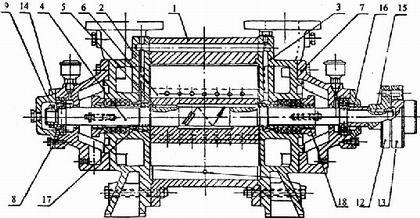
 Structural Diagram of the SZ Series Liquid Ring Vacuum Pump

Figure 3

  1. Pump body 2. Rear cover 3. Front cover 4. Pump shaft 5. Flat key 6. Impeller 7. Bearing housing 8. Ball bearing 9. Round nut 12. Pump coupling 13. Motor coupling 14. Bearing cover 15. Key 16. Positioning ring 17. Shaft sleeve 18. Packing gland


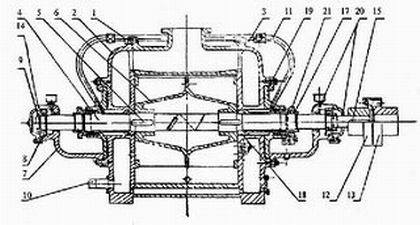
 Working Principle of the SZ Series Liquid Ring Vacuum Pump

Figure 4

  1. Pump body 2. Rear cover 3. Front cover 4. Pump shaft 5. Flat key 6. Impeller 7. Bearing housing 8. Ball bearing 9. Round nut 10. Inlet pipe 11. Seal pipe 12. Pump coupling 13. Motor coupling 14. Bearing cover 15. Key 17. Shaft sleeve nut 18. Shaft sleeve 19. Stuffing box 20. Felt ring 21. Stuffing box gland

  The SZ vacuum pump consists of a pump body (1) and two side covers (2) and (3) (see Figures 3 and 4). The lower part of each side cover is supported by pump feet (a) (see Figure 2), while the upper part features two pipes—the intake pipe (c) and the exhaust pipe (f). These two pipes are connected to the pump chamber through intake ports (d) and exhaust ports (g) located on the side covers. On the SZ liquid-ring vacuum pump body, the intake and exhaust pipes are connected to the intake and exhaust ports on the side covers. The shaft (4) is eccentrically mounted inside the pump body, and the impeller (6) is fixed onto the shaft by means of a key (5). The clearance between the impeller and the side covers is adjusted by shims placed between the pump body and the side covers to set the overall clearance. The impeller is pushed by a sleeve (17), thereby adjusting the clearance at both ends of the impeller. This clearance determines the magnitude of gas flow losses as the gas moves from the intake port to the exhaust port within the pump.

  The SZ vacuum pump stuffing box is housed within the two side covers (2) and (3). Behind the packing, there is a water chamber into which water enters via pipe (11). Part of this water passes through the packing to cool the stuffing box, while the other part flows into the pump body. Under the action of centrifugal force, it flows along the blade surfaces, completely filling the space between the impeller and the side covers.

  The ball bearings (8) of the SZ water-ring vacuum pump are secured to the shaft by round nuts (9).

  On the side cover’s sidewall (Figure 2), below the exhaust port (g), there are several rows of circular holes (e) equipped with rubber valves (spherical in shape) that remain closed. The purpose of these holes is to automatically release gas before it reaches the exhaust port, once the gas pressure between the impeller blades attains the exhaust pressure. This mechanism thereby reduces power consumption caused by excessive gas pressure.

  As shown in Figure 3, the structures of SZ-1 and SZ-2 differ from those of SZ-3 and SZ-4 (Figure 4) in that the intake and exhaust pipes are located on two separate side covers: one pipe is connected to the intake port, and the other is connected to the exhaust port. Moreover, the pumps do not include any rubber valves.

  The inlet pipe (10) of the SZ water-ring vacuum pump is connected to the gas-water separator to supply the circulating water required by the pump. To ensure tight sealing of the clearance between the two end faces of the pump cavity and the packing, clean cold water must be continuously supplied through the water-seal pipe (11). At the coupling end, a felt ring (20) is installed to prevent oil from leaking out of the bearing.

  Technical specifications:

  Note: 1. For SZ liquid-ring vacuum pumps, the suction and discharge volumes—ranging from a vacuum degree of 40% to 90% or a pressure of 0.05 MPa—vary depending on the water supply volume and the clearance between the impeller and the side cover.

  It varies in size, and especially when the flow rate is low, inaccurate adjustments can more easily lead to underestimation.

  2. The values shown on the SZ liquid-ring vacuum pump’s meter were obtained under the following conditions:

  ① Water temperature: 15℃

  ② Air at 20℃

  ③ Relative humidity of the gas: 70%

  ④ Atmospheric pressure: 0.1013 MPa

  3. The in-table performance deviation shall not exceed 5%.

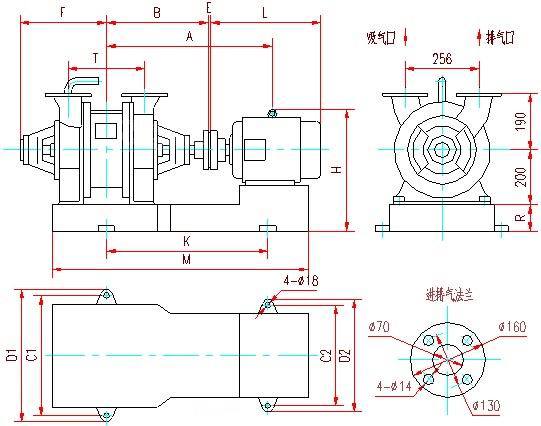
  Installation dimensions:


 Installation Dimensions for SZ Series Liquid Ring Vacuum Pumps

Friendly reminder: For more performance parameters of the SZ series liquid-ring vacuum pumps, please click → [Pump Selection] page to view.

Why choose us?

Changsha Zhonghlian Pump Industry Co., Ltd. was founded in 1989 and was independently established after the restructuring of Changsha Water Pump Factory. It is a comprehensive national high-tech enterprise integrating design, research and development, manufacturing, and service. The company was listed on the Hunan Provincial Equity Exchange on December 31, 2019, with the abbreviation "Zhonghlian Pump Industry" and the equity code: 600275HN. It is currently a key backbone enterprise in China's centrifugal pump industry and one of the major professional manufacturers of multi-stage pumps in the country. The headquarters is located in Changsha City, Hunan Province, a historical and cultural city in China.

41000 m²

Square meters of land area

100 %

100% factory pass rate

41000 m²

Square meters of land area

100 %

100% factory pass rate

Image Name

Q

What is your typical delivery time?

A

Models in stock can be shipped the next day at the latest. All others are custom-made, with lead times generally ranging from 7 to 90 days depending on the product size and project specifics. Please contact our sales manager for details: 0731-88632200 。

Q

Do you have centrifugal pumps in stock?

A

Centrifugal pumps come in numerous models and configurations. Except for a small number of high-volume, standard models that are in stock, the vast majority are not stocked and are customized products. We need to select a pump based on your site's flow rate, head, media temperature, pH value, and installation conditions, etc., to determine the pump model and configuration before we can submit an order to the factory for production.

Q

What information should I provide when requesting a quote?

A

Generally, to obtain an accurate quotation, we recommend providing us with the following information: pump flow rate, head, on-site operating voltage and frequency, temperature, pH value, and solid particle content of the fluid being conveyed, and on-site installation conditions (horizontal or vertical installation), etc.

If you are not sure, don't worry, our business managers will assist you in determining this.

Q

What products do you mainly produce?

A

Zhonglian Pump Industry manufactures various large industrial centrifugal pumps. Main products include: self-balancing multi-stage pumps, multi-stage centrifugal pumps, single-stage centrifugal pumps, split-case pumps, chemical pumps, submersible pumps, pipeline pumps, long-shaft pumps, condensate pumps, etc.

Q

Could you help me with the selection?

A

Certainly! If the water pump model is not selected accurately, there will be big problems. If you choose a smaller one, it won't meet your needs; if you choose a larger one, it will waste electricity and fuel, increasing your costs.

Q

Why is it so slow to get a price quote?

A

Because centrifugal pumps are non-standard customized products with many models, the price range is also very large. Even for the same model, the price difference is also very large due to different materials and configurations. Taking the most common water pump accessory—the impeller—as an example, the price of a stainless steel impeller is several times that of a cast iron impeller. Therefore, we need to clarify the relevant information to give you an accurate price. Normally, if you provide relatively comprehensive information, we can quote within 5 minutes.

Product message

*Note: Please fill in the information accurately and keep the communication open. We will contact you as soon as possible.